Vet Veterinarian Pet Hospital St Cloud MN Sartell
Dr. Pamela Gerds
911 Scout Drive
Sartell, MN 56377
Open Weekends 9-5
Open Weekdays 7-7, Closed Wednesday
320.257.0911


Home
Emergency!
Veterinary Services
Sick Pet?
Lost Pet?
Digital X-Ray
Hours
Find Us Now
About Dr. Gerds
Surgery
Prescription Diets
Flea and Ticks
Dental Care
Day Care
Preventive Care

Why Don't Human Doctors use Laser Surgery Anymore?


Want "Laser Surgery" with your Tonsillectomy?

St Cloud MN Veterinary ClinicHazards of laser tools are often not shared with pet owners, like second hand smoke from burning flesh.*


Benefits of Laser Tools Unsupported by Fact


Ads for laser tools in veterinary magazines promise vet clinics huge sales and an "Advanced" image.

Vet clinics who bought the $45,000+ laser scalpels promote less pain and bleeding as benefits. Consumers buy into this because of guilt and no knowledge of facts.

Dr. Gerds reads respected veterinary journals like the Journal of the American Veterinary Medical Association searching for medical evidence documenting these claimed benefits.

Verifiable results for direct comparison of a laser scalpel vs. a steel scalpel are inconclusive at best.

The reduction in bleeding is often statistically and medically insignificant. A measurable reduction in pain is impossible to verify. Results of these comparisons appear later in this article.

Searching the internet long enough, one can find results supporting the superiority of either method.

Be aware, references of articles appearing on laser company websites and in lesser veterinary trade publications were often "underwritten" (paid for) by the laser companies themselves.


St Cloud MN Veterinary Clinic Education "articles" are often paid advertising in disguise.

The more important question however is whether a laser scalpel benefits the veterinarian, the patient, both, or neither.

If no conclusive medical benefit exists, is the method "advanced?"


ACVS - American College of Veterinary Surgeons

This professional organization of Board Certified Veterinary Surgeons, are the top of the proverbial ladder when it comes to the veterinary surgery standards and guidelines.

The comment below was from the ACVS (American College of Veterinary Surgeons) website, regarding declaws in felines and the use of laser:

"The laser is claimed to be less traumatic and cause less hemorrhage, swelling and pain, however, this has not been proven, however laser declawing is an acceptable method."

Therefore a laser "is an acceptable method," the claims of less bleeding, swelling and pain "has not been proven."

Retrieved 3.8.2012 from:
http://www.acvs.org/AnimalOwners/HealthConditions/index.cfm?ID=2840&blnShowBack=False&idContentType=939


Lasers in Human Cosmetic Surgery

In the 1980's and early 1990's. Lasers were once on the "cutting edge" of human soft tissue surgery.

Today however, laser scalpels only enjoy widespread acceptance in cosmetic or "aesthetic" surgery for tattoo removal, wrinkle removal, varicose veins. It is ideal for LASIK procedures.

For most procedures requiring soft tissue cutting, similar to most veterinary techniques, human surgeons have returned to conventional steel scalpels.

Makers of laser scalpel devices turned to the veterinary industry as an untapped market when sales to human medicine collapsed.

When Advanced Care Pet Hospital opened 2 years ago, Dr. Gerds invested in critical diagnostic tools like human grade ultrasound and digital x-ray. This technology is advanced. From a cost benefit ratio, spending $35,000+ on an electric laser scalpel which offers minimal measurable medical benefit, just did not add up.


Are Benefit Claims Fact or Opinion?

The benefits cited regarding less pain and bleeding using laser scalpels are not fully supported in fact by respected, leading journals of medicine in either the human or veterinary fields.

Unfortunately, there is relatively little solid, hypothesis-driven blind comparison research on lasers in veterinary medicine. Studies are expensive and slow to perform, analyze, present, and publish. The lay press seems to suggest, and pet owners would like to believe, that after a short painless procedure the pet goes home with no worries. That is not the case.


Manufacturer Marketing Pressure

The laser companies are quick to promote their electric scalpels and procedures, even before safety is well documented and laser doctors are fully experienced.

Aggressive marketing of lasers has contributed to their popularity among pet owners and veterinarians. However, significant controversy and confusion surrounds this practice.

Operator experience is very important. Commercial laser companies are marketing heavily to the veterinary profession. These companies present the laser equipment they are trying to sell as being simple to operate, and provide some seminars for training.

A laser scalpel is a sophisticated instrument and there is a learning curve involved before it can be utilized perfectly. Complications such as the burning of tissue and delayed healing are more likely with a less experienced user. The CO2 laser beam itself is invisible.


Patient Safety Precautions

The patient must be draped in a special fashion: the face is surrounded by wet cloths and shield to prevent fires (if the laser strikes dry cotton) or burns (if the beam strikes inadvertent areas of skin). Instruments have special nonreflective surfaces to minimize unwanted reflections, and the surgeon and all operating personnel wear protective glasses.

Laser scalpels also pose an explosive fire hazard when used with oxygen.

A filtered smoke evacuation system is needed to evacuate the laser plume. Typically, at least 1 extra person is needed in the operating room to monitor and run the extra equipment, and all personnel receive extra training in laser safety. Naturally, there is additional training and a learning curve for the surgeon.

All these factors contribute to higher over head costs and higher prices for consumers.


*Laser Smoke Hazards to Practioners

While there is little evidence of hazards or benefits of using lasers scalpels for pet surgery, significant documentation of the negative effects of laser smoke on the surgical team are well documented.

During procedures that use a laser scalpel, the thermal destruction of tissue creates a smoke byproduct. Each year, an estimated 500,000 workers, including surgeons, nurses, anesthesiologists, and surgical technologists, are exposed to laser or electrosurgical smoke.


The New SECOND HAND SMOKE!

Surgical smoke plumes have contents similar to other smoke plumes, including carbon monoxide, polyaromatic hydrocarbons, and a variety of trace toxic gases.

As such, they can produce upper respiratory irritation, and have in-vitro mutagenic potential.

Although there has been no documented transmission of infectious disease through surgical smoke, the potential for generating infectious viral fragments, particularly following treatment of skin growths, may exist.

While the surgical team wear masks (which do not trap smoke particles) your pet undergoing laser surgery won't have a mask to stop the smoke plume of their own burning flesh from entering their lungs.

This is why extensive smoke excavation systems must also be installed in the surgery room.

A laser surgery device and the required fan and duct work to evacuate the smell of burning flesh are VERY Expensive. We know, we have sales people trying to sell us the set up all the time. Dr. Gerds estimates that the all up installed cost of a decent unit to be about $40,000 with exhaust ductwork, special clothing, tools and protective gear for staff.


Here is a useful link for vet tech staff regarding laser safety protection:
OSHA.gov Laser Hazards for Veterinary Staff

The business must pay for the added overhead expense. The way one pays for it is by either offering "Laser Upgrades" or spread out the cost other ways. We are pleased to notice more veterinary clinics dropping the usage of an "Upgrade" price option as a marketing tool.

Little Evidence of REAL Value

Dr. Gerds finds little to no evidence that the short or long term results are significantly different than conventional methods. She has had to use a laser at a previous employer and found the smell and experience of burning pet flesh rather unpleasant.

Comparing a laser scalpel to steel scalpel is like using a Ferrari instead of a Prius to buy bread at the corner grocery.

They will both do the job fine but the cost of ownership and bragging rights vary a lot. We estimate we can buy about 350,000 scalpel blades for the price of a decent laser set up.

In short, laser scalpels are very expensive to buy. It adds an added cost for the vet clinic to buy. Higher overhead costs are passed along to the consumer. The claims of medical benefits are not scientifically greater than conventional methods. The marketing benefits are proven to increase sales for the vet clinic.

Conventional Techniques Also Blood Free

I have witnesses blood free declaws performed here by Dr. Gerds. She will leave a white towel on the table and you won't find a drop of blood on that towel.

Regarding pain management, Advanced Care Pet Hospital's pain management protocols meet or exceed AVMA and AAHA guidelines.

Healing Burning Flesh

Think. If you slice yourself with a razor blade, or you burn yourself, most people agree that a razor cut will heal and hurt less than a burn. Laser scalpels burn skin tissue. Below are some findings regarding healing after thermal damage from Co2.

Several Internet Findings

Title: Comparison of the Effects of the CO2 Surgical Laser and Conventional Surgical Techniques on Healing and Wound Tensile Strength of Skin Flaps in the Dog

Authors: Michael B. Mison DVM, Barbara Steficek DVM, PhD, Diplomate ACVP, Michael Lavagnino MS, MSE, Brian D. Teunissen DVM, Joe G. Hauptman DVM, MS, Diplomate ACVS, Richard Walshaw BVMS, Diplomate ACVS

Article first published online: 12 AUG 2004, DOI: 10.1111/j.1532-950X.2003.00153.x

Veterinary Surgery, Volume 32, Issue 2, pages 153–160, March 2003

Laser incisions had partial necrosis (dead flesh) of the wound edges and a more extensive inflammatory response; however, healing of the wound beds were similar regardless of technique.

Conclusions: The CO2 laser provided better intraoperative hemostasis than CST. However, overall healing and increase in tensile strength of the skin-flap junction of the flaps created by the laser may be delayed during the first few weeks of wound healing.

Clinical Relevance: Skin flaps used to repair large skin defects in dogs can be created and elevated with a CO2 laser. In areas of increased skin mobility or tension, skin flaps created with CO2 laser may be more susceptible to complications such as dehiscence, and care should be taken to minimize these complications.


http://www.skintherapyletter.com/2003/8.7/2.html Accessed 2/24/2012

The CO2 laser produces a zone of irreversible thermal injury (coagulative necrosis) along the wound edge, an observation that has been correlated with the well recognized delay in the rate of laser wound healing, postoperative wound dehiscence, and unacceptable scarring. As long as these tissue effects are recognized and understood, postoperative problems can be avoided.

For example, laser incisions should be made parallel to relaxed skin tension lines. This will allow wounds to be closed with the least amount of tension, thus reducing the risk of unacceptable scarring.

Similarly, cutaneous laser incisions should be placed in areas such as the head and neck that have a rich blood supply. When closing cutaneous laser wounds, I believe that absorbable suture materials should be avoided as the coagulative necrosis produced by the laser, in conjunction with the inflammation stimulated by the suture material can produce wounds with an unacceptable appearance. I prefer nylon or polypropylene suture, and leave the sutures in place approximately 7 days as opposed to the 3-4 days I leave sutures after cold steel blepharoplasty.

This gives the laser wounds an opportunity to heal more completely prior to suture removal.


http://www.ncbi.nlm.nih.gov/pubmed/7896488 Accessed 2/24/2012


  • Dr. Gerds does not use
    laser scalpels

    Benefits of less pain and faster healing are not supported in fact.

    Dr. Gerds has laser experience, she used one in a former clinic.

    She finds the smell of burning pet flesh most unpleasant.

    In her experience, she did not see any proof that lasers were better.

    Comparative results published in leading journals of medicine in both human and veterinary fields likewise do not support claimed benefits of laser scalpels.

    Lasers scapels cost vets between $25,000 to over $50,000 to buy, plus ongoing supplies.

    That extra overhead is passed on to you the consumer one way or another.


    Learn How Vets Increase Profit from You with Laser Surgery:

    Companies selling lasers to veterinarians clearly have ways to help them pay for the electric scalpels.

    Learn how laser companies teach clinics to increase profits using electric scalpels by following this link:

    Laser Surgery Marketing Tips for the Veterinarian

  • OSHA Hazards of Laser Surgery to Staff

    Read about the hazards laser surgery offers veterinary staff. Keep in mind, the same hazards apply to your pet lying unconscious on the surgery table. OSHA.gov Laser Hazards for Veterinary Staff


    9 ways People Used Radium Before Risks were known

    Frequently new technology is sold to people long before the risks were understood. Radium was an excellent example before radiation risks were understood. Read More…

Menu
Emergency!
Services
Hours
Find Us Now
About Dr. Gerds
Surgery
Prescription Diets
Flea and Ticks
Dental Care
Day Care
Sick Pet?

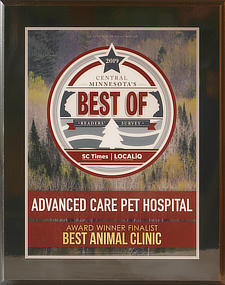
A Vet for our Times

Our goal is to be the vet you recommend to friends with pets. We are Central Minnesota's newest veterinary practice. We put together a great staff, current technology and a doctor with 17 years experience. Discover why so many already recommend Advanced Care Pet Hospital!

MN Veterinary Medical Association
Web Site Information

Copyright © 2013 Advanced Care Pet Hospital P.A.

American Veterinary Medical Association
Satisfied Customers

Read and post reviews by clicking: Advanced Care Pet Hospital Reviews. The best compliment you can give us is a referral to another pet person. Like us on Facebook to stay in touch.

Sartell Chamber of Commerce